MightyDreamer Mindset™
An online digital magazine featuring profiles, interviews, explorations in mastering communication, holistic wellness strategies, the vitality of words and reframing, published by MightyDreamer Mindset.
BEGIN THE EXPERIENCE
Words Live™
A MightyDreamer Mindset™ EditorialEditor’s Note
There are words we choose…and words that have been choosing us.Long before we question them.
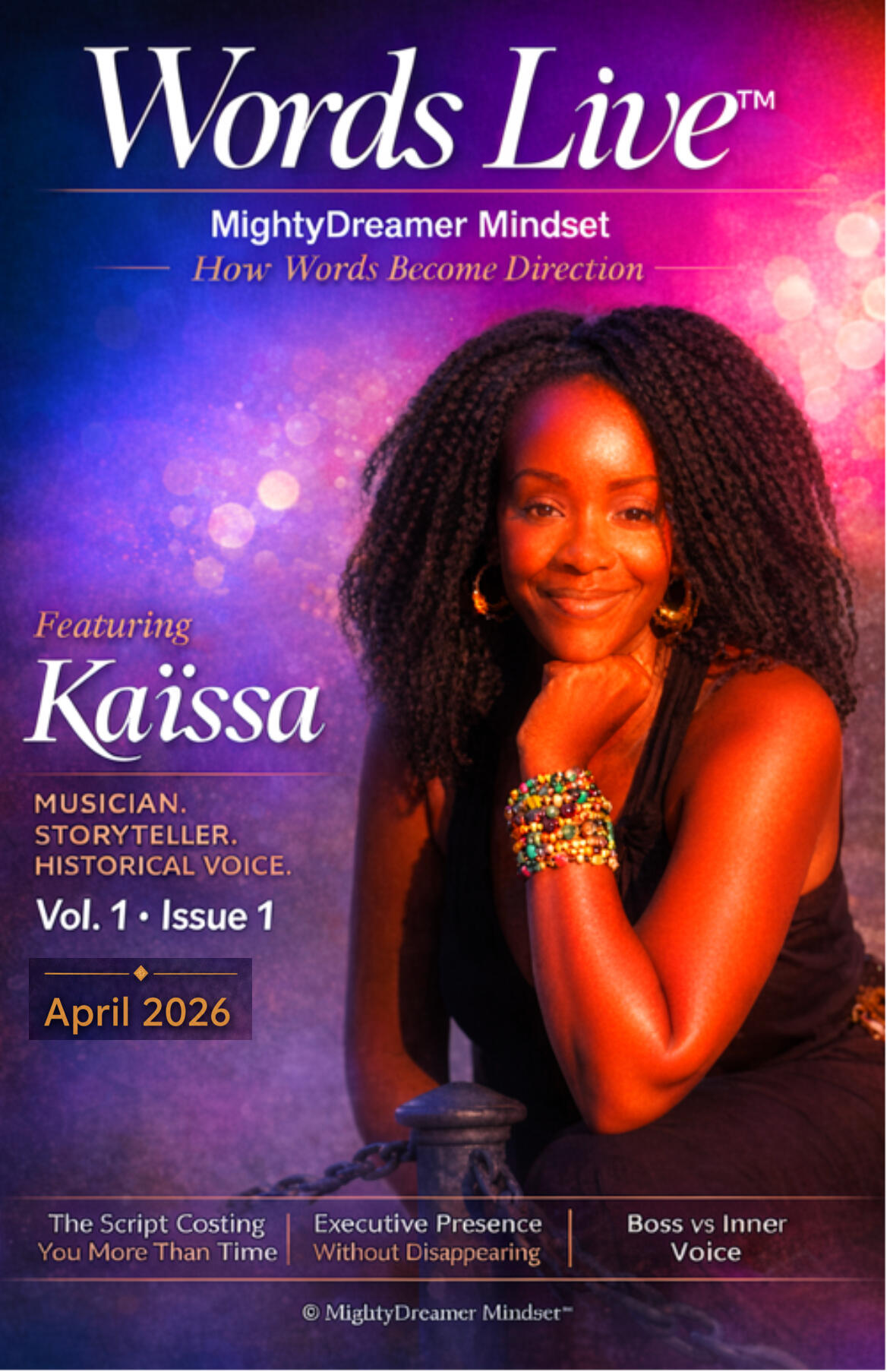
Long before we notice how they shape the way we show up, speak, lead, and live.This issue isn’t about finding your voice.It’s about recognizing the one that’s been there—beneath expectation, beneath adaptation, beneath everything that asked you to be something else first.FeaturingKaïssa
Musician. Storyteller. Historical Voice.Kaïssa doesn’t just perform—she carries memory.
Through music, movement, and the spaces she walks—New York and beyond—history becomes something more than something learned.
It becomes something felt.
Some voices entertain.
Others remember.
Kaïssa’s voice doesn’t just perform—it preserves.
It bridges time, carrying memory through rhythm, story, and presence.But not all voices begin as expression.
Some begin as inheritance.
Long before we speak, we are shaped—by what was said, what was silenced, and what was expected.By tone.
By reaction.
By what was allowed… and what wasn’t.We learn quickly:What is safe to say.
What is better left unsaid.
What gets approval.
What gets corrected.And without realizing it—
we begin to adjust.
The Voice That Carries History Forward
In Kaïssa’s work, this shows up differently.
She doesn’t just tell history—she walks it.In New York, and in spaces across the world where stories of Black lives, enslavement, resilience, and culture live beneath the surface, she brings people into something deeper than information.There’s a shift that happens when history is no longer something you read…
…but something you stand inside.
Something you hear.
Something you feel.
Something that—unexpectedly—feels familiar.Because inheritance isn’t always obvious.Sometimes it shows up as:
a hesitation.
a silence.
a knowing you can’t quite explain.We don’t just speak our thoughts.
We speak what we’ve learned to carry.And sometimes—
it takes voice, place, and presence
to finally hear it.
When Voice Becomes RecognitionThere’s a moment—
when voice stops being something we shape…
and becomes something we recognize.Not something we try to perfect.
Not something we adjust to be accepted.But something that was already there—
waiting beneath everything we learned to carry.In spaces where history is felt, not just understood,
that recognition happens differently.Not as explanation.
But as awareness.Some voices are discovered.
Others are remembered.And sometimes—
what we’ve been carrying
was never meant to stay silent.Interrupt the Script™What have you been carrying…
that was never yours to carry?
Listen to Kaissa perform below
To receive a FREE copy of Take Control click on the BLUE BUTTON ONLYUse the box below if you'd like more information or like to say hello. Thank you.
It’s interesting how often we inherit ideas without realizing it.
Ideas about success, relationships, work and who we should become.Some serve us well -some do not.The challenge is that many times we become so familiar with our actions, we stop questioning them. Some messages seem to find people long before people find them.A phrase. A lyric. A quote. A symbol.Something catches our attention, and for reasons we can't always explain, we stop. Not because it's fashionable. Because it feels familiar-somehow, it feels true.Perhaps that's what happens when people encounter a MightyDreamer or begin to look deeper into what having a MightyDreamer Mindset may mean.At first glance, it may appear to be a phrase. A design. A brand. A collection. But the longer you sit with it, the more it becomes a question.
What mindset? what’s mighty about a dream?A script that can stay quiet.
The script that says become who others expect you to be.
The script that says fit in at all costs.
The script that says follow the crowd, even if the crowd is headed in the wrong direction or merely lateral.In life and in some aspects of creativity, a script we may need to re-evaluated by asking is it true, worth it- or simply bullshit.One noticeable one is that we may run in our minds to say yes- when it is truly obvious to us a response should be NO!Most of us have encountered these messages in one form or another.
Some arrive through culture.
Some arrive through institutions.
Some arrive through family traditions.
Some arrive through fear.
Some arrive in the witnessing of a creative writing.The interesting part is that many of these scripts become so familiar we stop noticing them.
Until one day, we do through
A conversation.
A setback.
A breakthrough.
A new opportunity.
A different perspective.
Something causes us to pause long enough to ask a simple question:
Could this be my story or a storyline for me to recognize need to live?That question has changed lives.
It has launched businesses.
Started movements.
Inspired art.
Created inventions.
Transformed communities.
Not because someone followed the script.
Because someone interrupted it.The people drawn to this message are rarely looking for permission.
They are builders.
Creators.
Thinkers.
Artists.
Entrepreneurs.
Visionaries.
People willing to ask better questions.
People willing to challenge assumptions.
People willing to imagine a different future.
Not because they have all the answers.
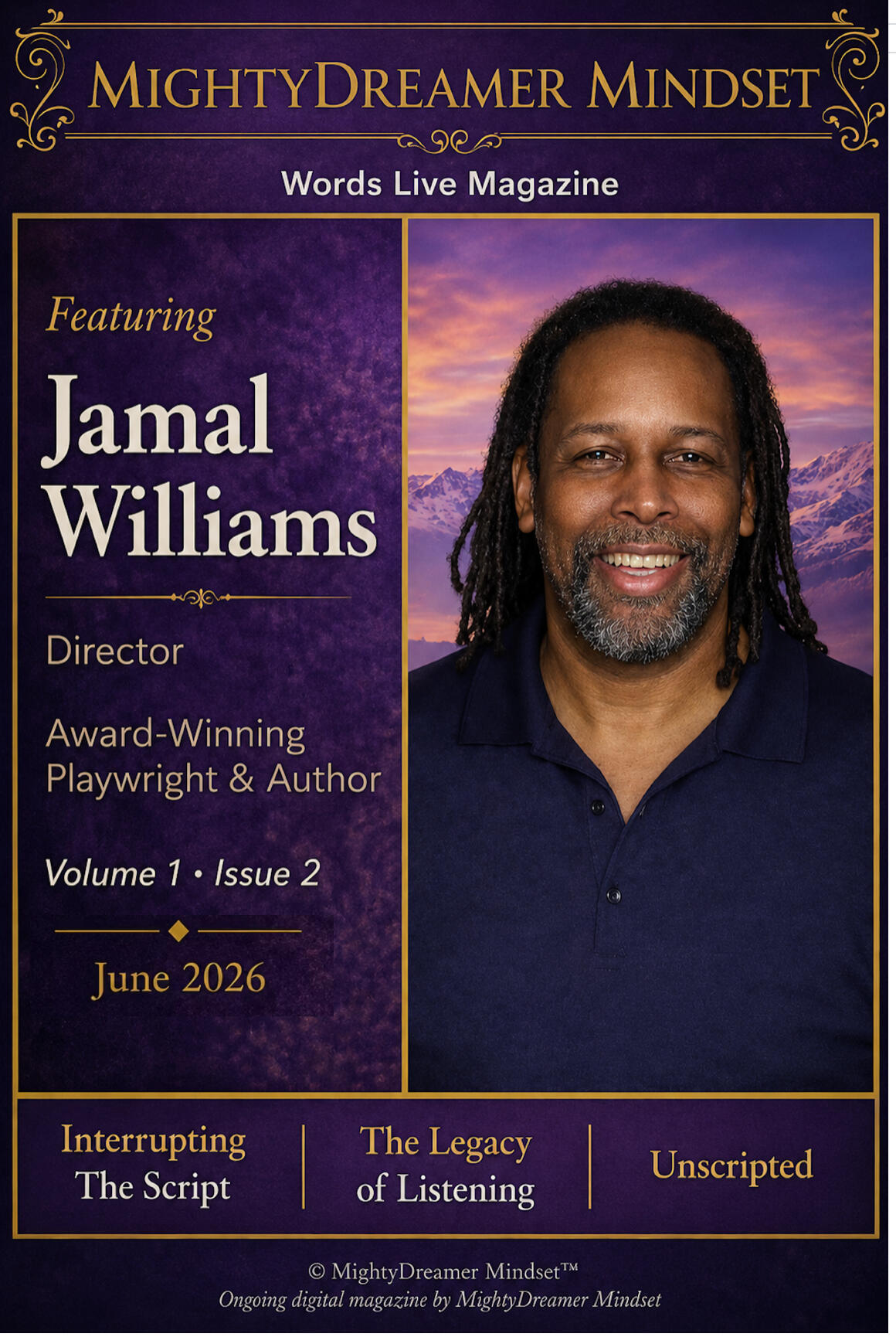
Because they are no longer satisfied with borrowed ones.They are MightyDreamers.The plays, novels, and creative work of Jamal Williams offer a compelling example of what can happen when purpose becomes more than an idea—it becomes a practice. For more than three decades, his work has invited audiences to think more deeply about how we listen, what we inherit, and ultimately, how we choose to live.As an author, playwright and director, he has worked with many established actors, who have gained through his writing and guidance, ability to visualize characters more authentically and dramatically.Professionally trained as a creative writer, holding two master's degrees and having served as director of more than one theater organization, Jamal Williams has built a distinguished career that spans decades. Although recognized through numerous awards and honors, he has remained committed to his own creative voice rather than conforming to expectations or trends.He manages to always find a moment in his character’s life that often goes unnoticed—the soul of their fears or the unknown. His storylines help us reflect on guidance in ways to be more patient, passionate, progressive, purposeful, non-judgmental and authentic.This is a writer, whether writing about historic figures like Dorothy Dandridge, Pearl Bailey and her luscious pie making, a preacher in at a podium during a funeral or expanded news coverage like the tiger a person was keeping in their Harlem apartment, Jamal's creations are truly works where words live beyond the expected but relatable for any generation to listen, learn and find relatable.They make for being uncomfortable in ways that will always leave viewers to look at life as an ever growing process of spirit, will and both the compromising and needs of the human heart.His horror stories are unmatched- twists that will tangle the mind asking for resolution and relief without being Friday, The 13th gory. Never appearing to be political, but can be provocative- a play we highly suggest to catch or read is a story about a convent when being reconstructed, aborted babies are found-and yes, it is based on a real story. The story follows one participant and the anguish she deals with daily.At MightyDreamer Mindset, we salute Jamal Williams and the work he continues to bring into the world. His story serves as a reminder that words have a way of living beyond the moment. Whether spoken or seen, they shape perspectives, influence choices, and often remain with us long after the encounter has passed. It is a reminder that words live.Let there be light—that your voice reflect your soul, not your fear.UNSCRIPTED
by Sharon L. WestI am a professionalProfessional childProfessional friendProfessional studentProfessional loverProfessional relativeProfessional cookProfessional house-clearProfessional managerProfessional executiveProfessional dream-keeperProfessional scapegoatProfessional beingProfessionally loved andProfessionally loathedI was and will always beA professional babyA professional vibe-every word I utter, I cannot take back.It cuddles, dictates, designs, distracts and demandsI must Over-stand the power of my wordsThey live forever-Oh lil kitty, running a pathWill you depend only on your kitty or follow a map?Word-Are these only my words?Are they yours?Forever?Never?In the hearts of everyone, everything you meet or greetThey can be calming, caring, not calming or not caringThey can be protective, directive, corrective, comicalPainful to be heard, painful when not metEcho they do throughout the universeMaybe the galaxiesCreated by you,ForeverListened to you, ForeverShe is passionate about her careerWhen XX walks into a room, it silencesWhen XX commands respect, causes shivers in attendeesWhen XX sets the tone of expectations-Intellect awakens in the receiver of an XX messageThey crave it, need it, deserve it-Frequency- Energy- Does Need to ApplyIt’s her jobThe glory of establishing peace for herself, for othersFor spaces and timeSay I’m the mother of earth—
Eternal existence and excellence adorns my crownThere is no Y without XNo AI would denyI have no choice then to be passionateWhat other life would or could I choose-
Ahh yes, not anotherA Reframe already, not just the power withBut the power withinSay I am a job-Unto being a career—I am light, bright, different for good causeIt’s duty to my being-Elegance in my workFor without it—There would be no post traumatic growth
No deprogramming of selflessnessAm I frequency
Am I coded? Yes- (repeat)Yes-
Can I add to it?Yes- now
Should I remember from where I’ve been?YesCan I manage more of me, more for me?Yes-Unless-Gremlins matter more than boundary-setting, peace, productivity, passion, purpose, power and prideWhat team will you join to win your mental war?
Who will you choice to be your captain?Why?
To continue your communication journey with MightyDreamer Mindset.
Sign up now for exclusive updates and gifts.Start with receiving our downloadable Take Control PDF below.
To receive a FREE copy of Take Control click on the PURPLE BUTTON ONLYUse the box below if you'd like more information or like to say hello. Thank you.
Communication has never been about merely speaking. It has always been about meaning.From the earliest symbols etched into stone to the speed of artificial intelligence responding within seconds, humanity has continually found new ways to exchange ideas. Yet one question has remained remarkably unchanged:Do we truly understand one another, or have we merely become better at transmitting information?
The difference matters.
Information travels at extraordinary speeds.Understanding rarely does.We live in a time where communication has become more accessible than at any point in human history, yet misunderstanding continues to shape families, workplaces, governments, and communities across the world. We have more ways to connect than ever before, but connection itself has become increasingly difficult to define.Perhaps the issue has never been communication, but how the various lenses affects reactions, directions and shape reality. It stands to be within its purpose and power how words or visions are interpreted or played in any scenario.
We can all agree that speaking serves the purpose of interaction that can direct or redirect how we respond, whether intentional or not--the narrative matters. It is not just how we speak, but what we do when we speak that can make or break a spirit, a person or community.*Communication creates meaning.
*Meaning influences perception.
*Perception influences direction.
*Direction influences innovation.Innovation should remain human-centered. Or should it? Can it?
Let's take a look at the innovation of AI through various aspects of what is becoming human centered AI learning, teaching and experiencing.
It could be that we may never know if there will ever be too much talk about how AI will take over our world—work, jobs, education or lifestyles. On the other hand, maybe not enough talk or inspiration on how it can be maintained to elevate our communications is not analyzed in plain language.Human beings are all in part responsible in the programming of AI. What is expected to be its thinking, like it or not, our interaction with it helps establish and construct its responses and planning.
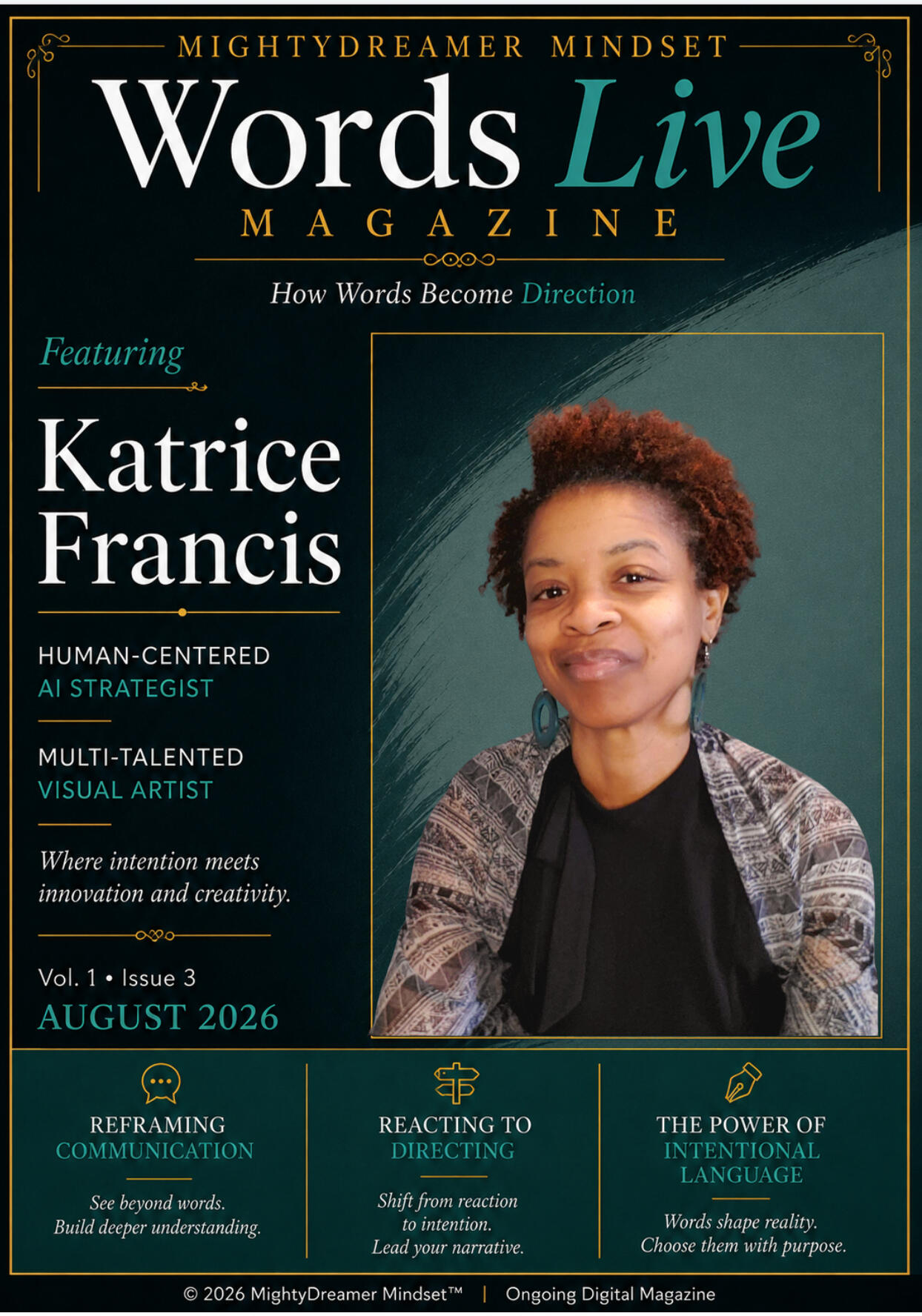
Innovations on how to make use of AI in all fields of government, wellness fields and building societal structures—even literally by brick and mortar are prominent and ever growing.Little discussion on how mental health can benefit from AI—except mostly in the use within coaching platforms—seems to be a dominant and growing factor. There is another side of mental health and wellness care that is becoming more established using AI and it falls in the ways of artistry that includes the need of it being an emotional art communicating with AI.Visual artistry does not have to be merely new abstract versions for instance—new far-out designs of futuristic looking beings with worldly backgrounds we may not have imagined or imagine could exist that look nothing like the common depictions of how the planet earth, its universe and the galaxy or galaxies it lives in has been drafted to appear.The intention of these type of artistic expressions are often based on conceptualizing what it means to have exotic flavoring and different portrayals of the natural as we know it.It is a matter of change management—marketing a new identity of visual art under the influence of future-focused imagination and anxiety-focused abstract art. Of course, this has its own genius.Interestingly, what has become a human-centered aspect of this type of art is a trend in mental health—art pieces created by individuals whose perception of their world on canvas or other—through their eyes, hearing and emotional experiences.Their visions some social circles and health professionals have often labeled abnormal are now shared communications of better understanding as they are no longer simply in the head of the seer, but seen by the sender and receiver—artist, patient, family member, stranger or friend to another viewing the pieces.The intention of these types of artistic expressions is often based on conceptualizing what it means to have exotic flavoring and different portrayals of the natural as we know it. It is a matter of change management—marketing a new identity of visual art under the influence of future-focused imagination and anxiety-focused abstract art.Of course, this has its own genius. Interestingly, what has become a human-centered aspect of this type of art is a trend in mental health— art pieces created by individuals whose perception of their world on canvas or other—through their eyes, hearing and emotional experiences.Their visions that in some social circles and by some health professionals labeled as abnormal—are now shared communications leading to better understanding, as the visions are no longer simply in the head of the seer, but now physically, maybe emotionally shared by the sender and receiver.The artist, patient, family member, stranger or friend to another viewing the pieces can now readily find more compassion, understanding, and perhaps make for less judgmental attitudes about what is now accepted as important visual concepts and expressions. Moreover, it has become a clear avenue as a healing process from trauma, anxiety and other emotional latent experiences no longer running through their heads and hearts. It is helping to normalize their insight and a stronger ability to verbalize.According to Cathy Malchiodi, a leading researcher in expressive arts therapy, "Neurobiology research has taught us that we need to 'come to our senses' in developing effective components for trauma intervention."Trauma often lives below language, held in the body's sensory memory — which is exactly why color, texture, and movement can reach it in ways words alone sometimes can't. This is why so many who create from their own emotional history aren't simply coping, they're translating — turning what once lived as static or shame into something that can be seen, named, and understood.Yayoi Kusama is one of the clearest examples of this shift. Early in her career, she was dismissed by Japan's art establishment because of her mental illness — the very thing now understood as the source of her most iconic work. Rather than let that exclusion define her, she leaned fully into her own imagination, and the hallucinations and psychiatric experiences she once had to hide became the foundation of a body of work now celebrated across the world.Her story is a reminder that what gets labeled as illness in one era can be recognized as vision in the next — not despite the experience, but because of the honesty poured into it.Frida Kahlo's inclusion in this conversation goes even further than her physical pain. She lived openly as a bisexual woman in early-20th-century Mexico, at a time when almost nothing about a woman's identity was allowed to be fully seen — not her body, not her heritage, not who she loved.Rather than separate these pieces of herself into what was acceptable to show, she painted all of it: her indigenous roots, her disability, her relationships with women, her grief. Her work wasn't just a record of trauma — it was a refusal to be edited down to fit anyone else's comfort. That refusal is its own form of healing, and its own form of inclusion: the insistence that every part of a person's story deserves space in the frame.These are all visionaries, who have turned emotional, mental and life challenges into forms of art. Communication is an art and we’ve covered a lot about it as a means of redefining communication in mental health with artistry.Expressive arts therapy as it is clinically known is not only by hand, but increasingly being aided by AI interpretation or enhancement making for— a human-centered AI strategy. The changes and results have been shown to make for less unfavorable judgment of self or by others due to managing mindsets of senders and receivers of these art pieces—a healing process and new conditioning of acceptance.Now, there seems new levels of mental health aligning are to be explored in our direct need for staying emotionally empowered as the learning curve of AI techniques continue to grow in our communications daily— it’s becoming no less than an art.Change management becomes a different approach than merely medicating as a “fix” or a need of conforming to a “normalcy.” There’s a sense of abstract thinking that can be compared to the onset of learning how to communicate with AI.Often managing change comes with challenges of insecurity, anxiety, confusion, stress and mostly, lack of self-care during transitions. There is a new overwhelm that comes with the learning curve of Al which includes generational awareness and generational gaps, coupled with gaps in how to remove feelings of loss, lack of confidence or frustration during a time in one’s life when the thoughts of aging would be long-term normalcy and foreseen expectation.Many older adults—especially women—are struggling with keeping well, feeling abnormal without AI or stumbling with how to use AI beyond the technical aspects or with the learning curve in general while keeping focused and emotionally fortified.There is an overload of specialist equipped on helping to train teams how to scale an AI business or make use of AI to scale a business. There are individuals and companies specializing in how to help turn a one-man business into what seems like a corporation fully staffed using AI agents.They are often referred to as AI Strategists. Their work is powerful and substantial in the need of understanding the mechanics, but the lack of psychological adaptation is not part of their work when using AI. A human based AI Strategist is rare to find, especially one who has had boots on the ground with training in both wellness care and the psychology of adaptation in the ever-growing world.What about the human beings? How does or can an AI Strategist help learners maintain their own emotional well-being during AI education? What could assist AI learners manage being human centered in their approaches for mental health safety?Where intention meets innovation and creativity, it often starts with trauma or reflection upon challenging moments, lack of expectations or events that can be positively reframed as how "Things don't happen to us; they happen for us.” Such is the case for individuals like Katrice C. Francis. Health scares. Burnout. Reinvention. Niche.The kind of reinvention nobody signs up for but everyone eventually faces. She didn't just survive that stretch — she moved through it— and moving others she does relentless in the AI movement helping guide them through challenges that make for epic management of their interaction with AI with new findings in reframing, reinvention and resilience in their personal lives as they pursue their professional stances in and with AI strategies.Our featured visionary Katrice C. Francis is someone we call a visionary artist in her own right, not for painting or sculpture, but for the way she sees what others haven't yet, and helps women stay emotionally grounded while navigating one of the steepest learning curves of our time. Katrice has walked that curve herself, felt the disorientation of it firsthand, and turned that lived experience into a method for guiding other women through the same thing.Madame Katrice’s own path wasn't a straight line into strategy—it moved through health challenges, burnout, and the kind of reinvention that forces a person to ask what any of it was for. Rather than treat that disruption as something to recover from and move past, she let it become the lens she now brings to her work.That reframe became the through-line of how she coaches — using AI not as a replacement for that inner process, but as a partner in it, helping the women she works with research their own health, weigh their next direction, and make sense of their experience as something usable rather than something to simply survive. Helping women to remove AI as a work to be accomplished but instead, a tool for personalize use—intentionally rewording its worth or why professionally it may be needed.Her company’s name is based on her theory, “Grow2Go”— a dual principle— the need to grow so you can go and to go you have to grow—trauma, drama or not. Her wellness coaching angle incorporates that meaning within her AI learning and teaching as to the importance of staying mentally fit—keeping the human within during the process.As a Human-Centered AI Strategist for women 40+, her experience and dedication help others remain grounded in one essential truth: emotional fitness and technological fluency are not separate tracks.
"You can't ask a woman to adapt to AI without also tending to the nervous system trying to keep up with it."Katrice C. Francis both embodies and empowers her clients through firsthand experience, guiding them toward:*Not reacting to fear of AI—but directing learning.
*Not reacting to overwhelm—but directing adaptation.
*Not reacting to uncertainty—but directing confidence.
*Not reacting to change—but directing reinvention.These are all premises of reframing the words we hear, the stories we see, and the conversations we have with ourselves—words that can leave women feeling weary, struggling with imposter syndrome, carrying unnecessary guilt, or losing the power of intentional language that shapes positive mindsets, clearer roadmaps, and inner direction for healing and growth.That, in the end, is the through-line of everything above: insight born from experiences that once felt disqualifying, now recognized as exactly what makes someone worth listening to.Continue the conversation with Katrice C. Francis on the upcoming podcast episode of PHD – People High on Determination.
To receive your FREE copy of TAKE CONTROL CLICK the BLUE LINK ONLY
This month’s edition covers our motto: "How things don’t happen to you, they happen for you" we are hopeful as a theme throughout. It extends into how frequency can effect outcomes many talk about online, but through the lens of how thing we see, react to or not—Is not only when looking into the left eye of an individual, but also how we project ourselves to the world as a form of designing our being: self and interaction.There is an old saying, “The eyes our the window of the soul.” It is imagined that you have had some experience with looking Into the eyes of someone and get a sense what their intentions may be whether favorable or not. Obviously, there are moments when we all, if one is not a great actor, recognize sadness, happiness, or other emotions, just looking into the eyes of someone.Some of you have been reading along with MightyDreamer Press long enough to know you will leave any published article, blog or chapter in a book published by it, you will leave with reframing perceptions of interactions, situations or thoughts. Sometimes through examining an individual or their work, sometimes making a reference.Speaking of which, when you look into the face of someone, do you look directly into their eyes, or maybe find your own eyes circling their entire face?What about noticing if when someone is looking at you, you’ve noticed they seem to have a preference of looking towards one side of your face or the other?Well, if you look into their left eye or you do this consciously or not ,when communicating with another, their is controversy as to a fact, there is good reason for doing so according to experts like neuroscientist Dr. Tara Swart.Dr. Swart suggest that looking at a person’s left eye taps into their emotional center. I will leave it to you to deepen your own research on the matter. She calls her research and theory, “Emotional Resonance Loop.” If this has piqued your curiosity, a great place to start is watching her interview on The Diary of a CEO on YouTube, especially if you have a baby, small child or children in your care.For more detail on how the left side of the face is linked to the right brain which handles emotions and social cues, a great deal of what she also taps into helping to confirm her findings. I’d suggest looking into the areas of Contralateral Processing, Lateralization and Left-Face Biased Chimeric Effect (or Left-Side Bias) for more on brain, face and eye connections.Supplied at the end of this edition are a couple of scientific and psychology links you can also do deeper research on in these area.
If any of this is new information to you, would love to hear comments from you on how this insight you might use to be more aware of people you interact with, studying lovers, your surroundings or anything else.
What perceptions in your daily activities or life might change if you start using this tool directly?Perception is a personal experience. Sometimes the reads we have are common, often they come with a twist or a totally unexpected. Be honest. Do you have assumptions about people or things you see that you may or may not have experienced and if so, in what ways? We may need to ask ourselves at times if any of our biases are inherited scripts.Some of you may be able to relate to seeing people living on streets on without a home, especially today on a regular. If you have been an adult for more than 20 years, your perception of what it might be why a person has fallen on those times, quite different than how you perceive them today. How it would make a difference on how you reacted may also be different—the understanding of the signal may or may not be as on autopilot.I was living in NYC during my early childhood days. My dad would take me to an area called, The Bowery. He used words like bums, derelicts, lazy when it came to the numerous people he would show me lying in squander with smells of urine and alcohol stench in the air. It was mostly as a lesson for teaching me to thrive in life so I wouldn’t end up in situations like that—truth of the matter, most of the people during those days were alcohol addicted. Why? Neither of us knows.To me then, I would think probably because they couldn’t stay away from the temptation of spirits. With the wisdom, social knowledge and experience I have today, if I had it then, I would question, for example, how many of them were service men—especially those who chanting words of distress, even anger.Much of what we see is handed to us, an understatement by media mediums. One of the main area of concentration in obtaining a degree in Communication Arts is understanding foremost, “We are taught to think how we think” and it is up to an individual if they are complacent with this mindset or have a mindset of change.That change is not a revolt of a system, but systematically being biased in one’s thinking. A growth mindset is the reward. Being more compassionate is the reward. The beginning or end of self-actualization occurs and a stronger sense of being—our own and that of people we meet or greet.We all have our own journey--judgement may not have need for a face in so many situations. Surely, it is often our own handicap than effecting the judged when we do.The face we present is that of what we think we want, what we want, need and desire. One fascinating thing is how all that plays out in our daily existence, some may call soul or in our spirit. It may be quite interesting to first define what want, need and desire may generally mean as you ask yourself how do they truly resonate in your personal or even professional lifestyles."Desire wins over need and want.Needs and wants are often rational or biological, while desires are emotional and identity-driven.What we understand about ourselves often is rooted in understand that statement.It is both my personal and professional opinion being certified and credentialed in Applied Positive Psychology, health and wellness and more. by the International Coaching Federation. That’s not for me telling you, based on the last few paragraphs, it’s stated to help you with any clarity you may, desire about the statement I have made.How does desire, want and need differ? Only one leads to self-actualization.Let's take a look at their distant and guiding differences that can have more ability and assistance in finding purpose and more meaning in one's life or more purposeful decision-making that activates wellness and measures of abundance for all in life.
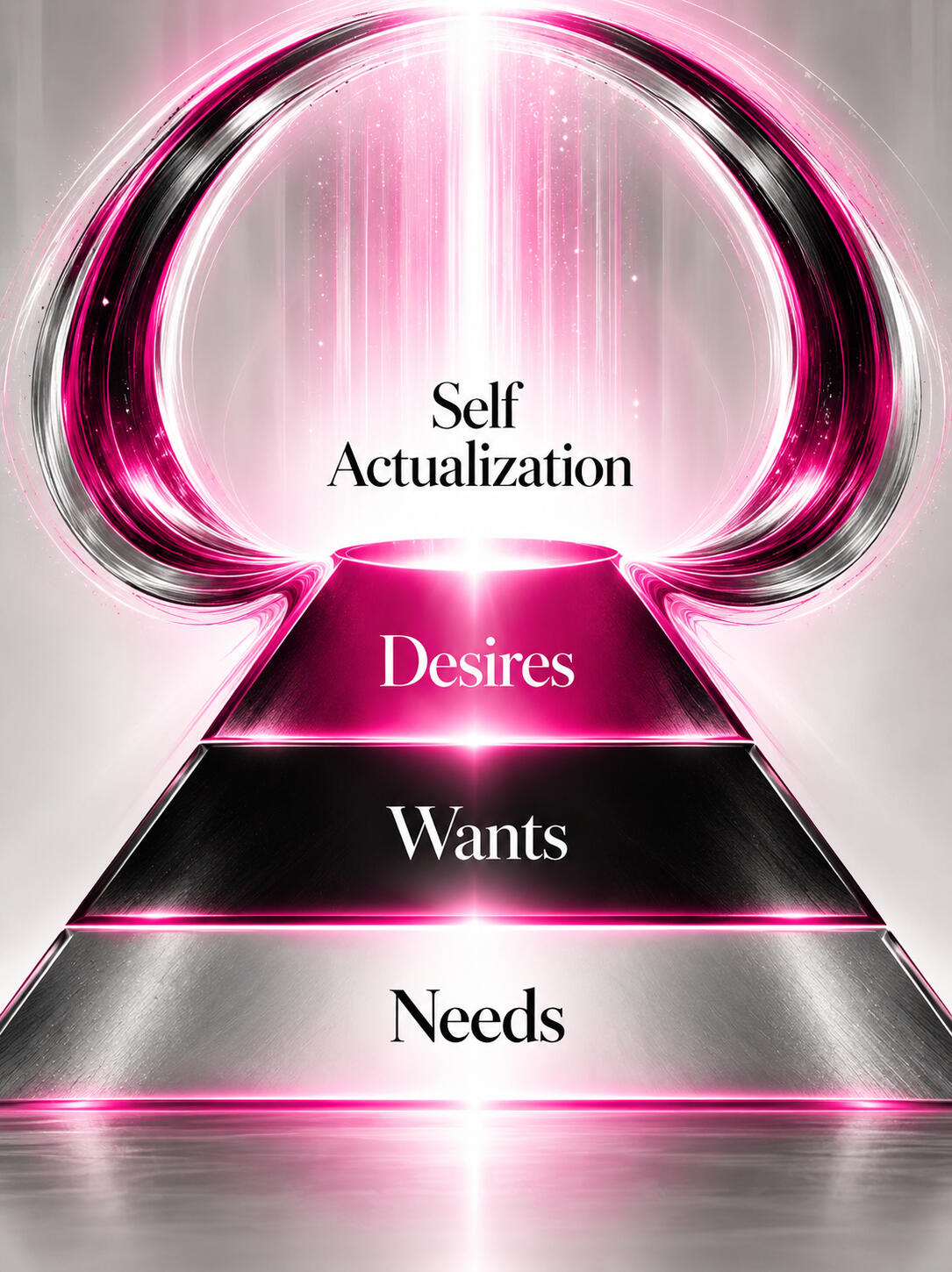
During the years, no matter the ethnicity, financial or social background of a client, or people that I have met in audiences, some of the same themes would come up in one way or the other the following:
Imposter syndrome/self-doubt
Feeling overwhelmed/poor time management
Not able to say no/prioritizing (especially self-care)
Fear of making the wrong decision/being stuck
Challenges talking through arguments/shrinking (mostly women)
Lack of meaning in and of life/finding purpose
Burnout/settling.
The list helps define what often is the underlying condition of them all—desire. It's the sole flipside of the hand of purpose and for becoming the best version of oneself.That may or may not be unlocking unique talents and abilities in purposeful ways. Yet often it is a matter of what one thinks is expected of them to be purposeful or successful. What often is found, we want to be able to share ourselves than do a thing. To test this out, next time you are in the presence of a young child, ask them, “What do you want to do when you grow up?”Consider the following experiment if you like. Instead ask them what they want to do. Initially, you may get a baffled look on their face. Ask them a second time. If they answer again with a want response, you may get a surprise response of something totally different or the same answer.If you do, question them again this way: “I didn't ask you what you want to be, I asked you what do you want to do?” For most children 7–9 or even younger, a spark will turn on and they respond with something purposeful. Love to hear what happened when you tried.If the directions sound odd in any way, your brain, like most of ours, is listening to inherited scripts, which I discuss in my book, Words Live: Erase the Codes. Do the exercise exactly as prompted. Let’s see what happens. It doesn’t matter if you receive a definitive answer as to something humanitarian. One way or the other, you have planted a seed that, in time, from within, will grow.Nearly 100% of the time, a child will respond when asked what they want to do when they grow up with a want—a thing-to-be response—not a sense of being. And it is that same child who becomes that want, only to find themselves baffled that they are not in the happiest state of being they expected to be.Words live as expressions of feeling. Those feelings can be triggered through one’s growth mindset, as well as post-traumatic growth. When someone may experience any form of mental discomfort or emotional challenge, most of us will agree, sometimes they can stay stuck in the experiences or gain insight into a need to change a habit or thinking process.By now, you may have been introduced to viral videos or shorts by Zachery Dereniowski, who can be an example of why I include him in the Words Live category of inspirational storylines as to how they live their lives and help in humanitarian ways. If you haven’t seen any of his videos or know who he is, you may consider researching him online as a means of understanding how we do not have to live in pain, suffering or lack of care when we have challenging moments.I’ll leave my statement there for you to expand on it through your own awareness gained from viewing Mr. Dereniowski in action. In fact, instead of me going into his background word for word, I’ve added a link where you can listen to him tell the story of how the words of two strangers changed his life—a life that has him duplicating giving, listening and showing deep empathy for strangers.You’ve heard my voice in many ways. You may have read through my blog at reframingcommunication.com, visited my website sharonlwest.com, already received newsletters from within my ecosystem or been part of masterminds together. What you have not witnessed is an invite to join me as a free or paid member of my channel that will be exploding with hot topics, guests, skills training, shared experiences and learnings as communities.This is not a shameless plug, me inviting you to subscribe to my YouTube channel, UNSCRIPTED.You see, I am not just the editor of this magazine, but a Growth Architect, Keynote Speaker and Author who emphasizes my personal desire to be impactful with my life as a listener and guided support system to the desires, wants and needs of others. Nothing satisfies me as much as walking in that light—not even solid ice cream, which I seem to not be able to get enough of all the days of my life—as it feels purposeful for me. I’m for anyone who truly needs an agency of change—workflow, mindset, confidence building—the ability to set boundaries for self and others without harm to self or another.These are some of the “how-to” elements of planning requests by my clients that include women 40 and maturing who are executives, entrepreneurs, small or midsize business owners looking to scale, while managing to shift mindsets or habits that cause them to shrink, second-guess themselves or lack actionable steps for self-care. You can see a few comments by a few previous clients at www.sharonlwest.com.Naming a few accolades, showing on paper, in person or talking to you now is not who I am. What represents me is my desire. I let it rule my directions, and it is that passion that assists emotional, mental, social and economic growth in those I partner with as a Growth Architect and Life Strategist. The education is the background, the experience the doorway I have walked 1,000s of times successfully, living the best life I can to help others, live theirs.
RESOURCES
(1). Science Direct / Elsevier: Host hundreds of peer-reviewed studies detailing the Chimeric Face Task and hemisphere dominance. item
(2). APA PsycNet (American Psychological Association): The premier repository for psychological science, housing decades of behavioral data on how the left visual field prioritizes facial emotions.
(3). For Brain Lateralization and Social Empathy (NCBI Bookshelf NBK10808): NIH.gov
(4). Google Scholar: You can pull open-access PDF versions of the foundational medical papers by searching for "Chimeric Face Task lateralization emotion" directly on www.Google Scholar.com
(5). For the Chimeric Face Task and Hemisphere Dominance: nih.gov
945513 Promo

Have a Light Day!
MightyDreamer Press © 2026 Editor
Sharon L. West, ICF-PCC, APPC, MCHC, CBC